
Capabilities
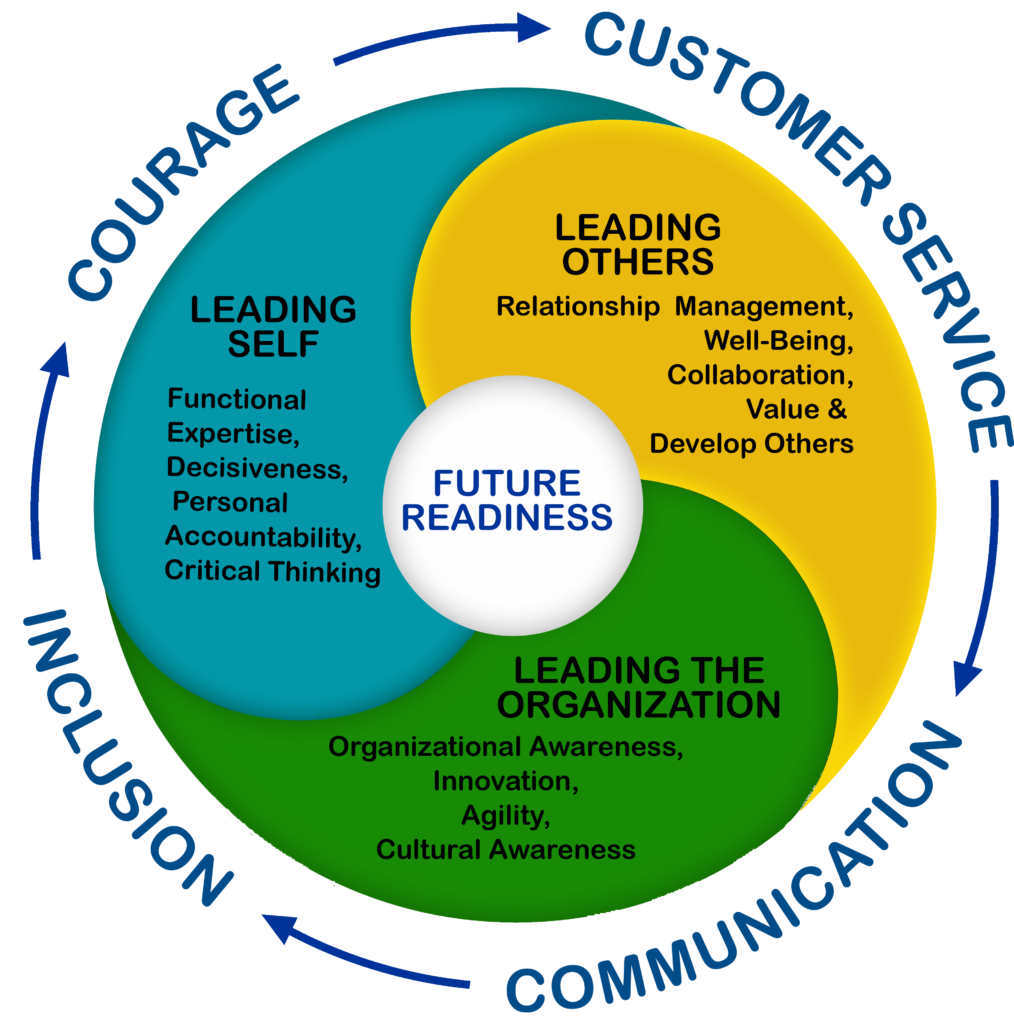
As committed public servants, we know our impact goes beyond the functions of our jobs. The Henrico County Capability Model reflects our commitment to hiring, developing, promoting, and supporting people who demonstrate inclusion, courage, customer engagement, communication, and leadership.
The core of this model is future readiness. As organizational and community needs change and evolve, so must we. Future Readiness means understanding today’s demands while thinking strategically about what comes next. For employees, this means staying aware of what’s needed today while preparing and planning ahead to meet the needs of tomorrow. For supervisors, it means equipping teams with the tools and support needed to meet future challenges with confidence.
This model was introduced in 2022 and serves as both a performance framework for employees and a guide for how we hire, promote, and design learning across the organization.
The list below provides example of behaviors, performance goals, and performance narrative to that may be useful during Performance Appraisal season. To learn more about annual, this important feedback tool, please visit the Performance Appraisal webpage.
Individual Capabilities
Inclusion
Acknowledging and showing appreciation for the individual differences, contributions, and talents of all team members, and strengthening employee confidence in their abilities.
- Actively seeks to collaborate with employees who have diverse perspectives and skills to foster inclusion, creativity, and workplace innovation. Supports ideas and diverse perspectives shared by team members.
- Encourages expression of different points of view. Listens to different views with respect and understanding of diverse perspectives before making decisions.
- Takes actions that demonstrate consideration for the individual feelings and needs of all employees. Speaks up to address inequities regarding diversity and inclusion in the workplace to foster an equitable environment for all employees.
- Proactively evaluates practices and processes to avoid negative impacts or unintentional exclusion.
- Consistently creates a supportive and trusting environment for open dialogue on diversity and inclusion.
- Empowers all team members to share thoughts and concerns openly without fear of negative consequences; initiates these conversations as needed among team members.
- Speak up about diversity and inclusion concerns and bring awareness to positive, inclusive actions.
- Acknowledge who is in the room, who is missing from the conversation and take steps to include other voices.
- In your supervisory role, encourage everyone to share ideas during meetings and take steps to manage dominant voices to allow other voices to be heard.
- Offered assistance to a new employee as they onboarded to ensure they felt welcomed and understood processes, procedures, systems, etc.
- Listened to and welcomed diverse views and opinions from others and acknowledged them with respect.
- Involved others in decisions, initiatives and operations that impacted their work.
- Asked others for their opinions and input through informal discussions and meetings.
- Recognized how specific contributions positively impacted the workplace and provided feedback.
- Approached citizens and customers with respect for their individual needs and circumstances.
- SUPERVISORS: Created an environment where employees were empowered to share ideas without fear of rejection or judgment.
Courage
Willingness to navigate uncomfortable situations, adhere to vision and values, take action and initiative on new ideas, and question assumptions and processes to improve outcomes.
- Demonstrates willingness to challenge own ideas, processes, and assumptions.
- Acknowledges own limitations and actively seeks on-going feedback to promote learning and professional development; Open to constructive feedback from others and makes personal adjustments as needed.
- Embraces dialogue to achieve desired goals and outcomes.
- Actively takes initiative and explores new ideas and technologies.
- Appropriately questions current conventions and creates new processes and initiatives to foster change and best meet organizational needs.
- When sharing constructive criticism about organizational practices, bring 2-3 solutions to address those concerns.
- Receive feedback constructively and actively engage in conversations about solutions. Embrace and support organizational change even when it’s uncomfortable for you (I.e., we have always done it this way).
- Respectfully approached colleagues, sharing the potential impact of decisions, and suggested viable alternatives to improve outcomes.
- Volunteered to take on a project or additional work outside the scope of their regular job duties and responsibilities.
- Stepped out of own comfort zone to do something (i.e., spoke to a group of citizens, taught at in-service or volunteered to lead an operation).
- Engaged in positive and productive dialogue to explore solutions that would benefit the organization.
- Respectfully intervened when a coworker experienced difficulty handling a situation.
- SUPERVISORS: Demonstrated openness through soliciting feedback, challenging own assumptions and asking for input.
Customer Engagement
Cultivating positive relationships with internal and external customers by proactively seeking customized solutions to increase satisfaction and build rapport.
- Anticipates customer needs and works creatively to meet those needs.
- Responds effectively to customer concerns, complaints, and ideas.
- Makes decisions that meet customer expectations.
- Adapts departmental processes and procedures to ensure greater outcomes for customers.
- Transparently provides information and/or reasoning to customers as needed.
- Start the conversation with what we are able to do instead of what we cannot do.
- Manage negative tone and body language when interacting with customers; customer requests are not an interruption.
- Explain to customers the reasoning and rationale behind decisions.
- Acknowledge customer concerns and feelings.
- Automated and converted processes to electronic format for citizens to continue to do business in an innovative way (i.e., implemented virtual story times for children).
- Helped a citizen whose car broke down and stayed with them until the issue was resolved or support arrived.
- Recognized that their coworker was overwhelmed and offered assistance (e.g., helped in an area outside their responsibility).
- Proactively reached out to multiple contacts beyond traditional resources to help a citizen in crisis.
- Acknowledged citizen’s concerns and feelings in times of stress.
- Proactively engaged with and reassured a concerned citizen regarding a water main break affecting them and communicated updates.
- Created and delivered programs to educate and engage citizens. (e.g., in exhibits, and events such as heritage months, holiday events and celebrations.
- Invested time with customers to build relationships, trust and understand their needs (e.g., participated in National Night Out, established relationships with business owners in patrol area).
- Educated citizens and county employees on energy conservation and recycling opportunities.
Communication
Expressing thoughts, ideas, and information effectively.
- Communicates verbally and in writing in clear, succinct, and understandable ways.
- Listens attentively to the ideas and concerns of employees and customers.
- Uses diplomacy and tact when engaging in difficult conversations.
- Effectively addresses conflict with others. Confronts inappropriate behavior.
- Adjust communication style for situation, audience, setting and timing.
- Take active steps to address and resolve conflict including getting supervisory guidance, seeking resources and classes.
- Share written communication with two approved people before sending to customers.
- Adjusted communication style based on the situation and the audience.
- Respectfully engaged in difficult conversations in order to resolve differences.
- Used diplomacy and tact to provide feedback to others.
- Actively listened to others ideas, asking questions to further understanding. Took active and appropriate steps to address and resolve conflict.
- Engaged in mutually respectful dialogue, displaying openness to other perspectives and ideas.
- Demonstrated empathy where appropriate when communicating with team members.
- Provided feedback and shared ideas openly with others (e.g., to a coworker, on a process or idea).
- Routinely demonstrated an understanding of the Division’s mission (e.g., Police’s five universal truths) and put them into practice.
- Created thorough reports, and or documentation of service calls.
- SUPERVISORS: Consistently communicated processes, expectations and goals to team to help them perform their job duties.
Leading Self
Decisiveness, Functional Expertise, Personal Accountability, Critical Thinking
- Makes decisions based on sound facts, values, and the best information available.
- Makes quick decisions confidently, firmly, and effectively under conditions of uncertainty.
- Considers costs, benefits, and risks when making and implementing decisions.
- Makes responsible decisions on how resources are allocated.
- Takes responsibility for results of decisions.
- Keeps up-to-date on information in area of expertise.
- Seeks broad business knowledge and knowledge of field.
- Demonstrates competency over a wide variety of job tasks.
- Effectively plans, organizes, and manages own time and work.
- Behaves in an ethical, honest, and trustworthy manner, and demonstrates
- integrity in all situations and interactions.
- Builds trust by keeping word, commitments and promises, and maintaining confidentiality of information.
- Demonstrates commitment to organization, its mission, and values.
- Garners personal credibility from others through professional conduct.
- Turns mistakes into learning opportunities.
- Thinks and acts strategically; shows an understanding of organizational impact.
- Identifies and implements ways to improve processes and solutions.
- Effectively analyzes the situation and collects information to make informed decisions.
- Examines and objectively compares situations from multiple perspectives.
- Develops solutions that achieve beneficial results for the customer and the organization.
- Decisiveness: Make decisions confidently, firmly, and effectively when managing complex projects with multiple stakeholders.
- Personal Accountability: Follow through on committed deadlines.
- Critical Thinking: After collecting information, critically assess and analyze the data for organizational needs
- Effectively planned and organized their time and work, and followed through on deadlines.
- Took responsibility for their own professional development by taking initiative for self-improvement (i.e., signing up classes, programs and certifications).
- Enhanced understanding of their profession through research, job shadowing, and reading trade
- publications.
- Embraced mistakes as a learning opportunity and took ownership for personal actions. Reflected on what could have been done differently.
- Looked at situations from different perspectives before making decisions.
- Made quick, firm decisions in critical situations when time was of the essence.
- Displayed good judgment by critically assessing and analyzing data before making decisions as when situationally appropriate.
- Performed all follow-up investigations in a timely manner.
- Actively solicited and stayed open to feedback from others on ways to improve future performance.
- Actively participated in debriefs and did not hesitate to identify areas for self-improvement.
- Proactively used all resources and technologies available to perform role.
Leading Others
Relationship Management, Well-Being, Collaboration, Value & Develop Others
- Demonstrates ability to positively relate to and connect with people across the organization.
- Treats others with respect; takes actions that demonstrate consideration for the perspectives, emotions and needs of others.
- Demonstrates self-awareness, including personal strengths and weaknesses.
- Adapts style and behavior to individual situations to build stronger relationships.
- Encourages others to share ideas for improved effectiveness.
- Communicates clear expectations when leading others, teams, and projects.
- Effectively motivates and guides others through positive communication and effective problem-solving.
- Identifies stressful aspects of work and cultivates the necessary skills to handle stress through self-care, self-management, and personal actions.
- Keeps informed about organizational resources that support wellbeing (financial, physical, mental, emotional, social, etc.).
- Shows concern for others’ well-being and supports their healthy lifestyle choices and behaviors.
- Facilitates discussion, and fosters open communication with team or other stakeholders.
- Supports inclusivity through awareness of and respect for diverse individuals and viewpoints.
- Builds consensus for approaches to establish goals and processes.
- Shares responsibilities and supports others to achieve common goals.
- Places group and organizational goals above personal goals and/or recognition.
- Practices cross-functional collaboration and teamwork across divisions and departments.
- Empowers employees at all levels to make decisions and take on leadership roles (formal and informal) to accomplish team and organizational goals.
- Provides honest, helpful feedback, both reinforcing and corrective, discussing specific behaviors and explaining the impact.
- Encourages others to pursue professional development opportunities to achieve professional and personal goals.
- Ensures everyone understands each other’s roles and responsibilities and how they relate to the County or department’s results.
- Acknowledges and shows appreciation for the individual differences and talents of others. Seeks opportunities to share knowledge, skills, and expertise with others.
- Relationship Management: Consider the impact of your decisions and actions on others.
- Well-Being: Proactively communicate about wellness resources and be open to adjusted schedules while meeting team needs.
- Collaboration: Demonstrate willingness to actively include colleagues’ thoughts and ideas on your projects.
- Demonstrated self-awareness by identifying own strengths and areas of development, and were mindful of how their behavior impacted others or was perceived by others.
- Willingly shared information and expertise with coworkers to set them up for success (e.g., conducted roll call training).
- Empowered employees through encouraging decision-making and utilizing new and innovative methods of getting work done.
- Provided regular, ongoing feedback, both positive and constructive, to help employees grow and succeed (“no surprises”).
- Encouraged their teammates’ professional growth and development by encouraging them to engage in professional development opportunities.
- Offered advice to newer employees and was always willing to support them where needed.
- SUPERVISORS: Supported employees in their efforts to manage their wellbeing. Encouraged them to take care of themselves and reminded them of options available to help them recharge and stay healthy.
Leading the Organization
Organizational Awareness, Innovation, Agility, Cultural Awareness
- Recognizes, understands, and aligns actions with organizational goals and objectives.
- Understands and effectively navigates the organizational dynamics that
- Recognizes the ripple effects that can occur across departments and functions from any given change or decision.
- Communicates the big picture to accomplish team and organizational goals.
- Accepts, supports, and helps implement change and management decisions, even if not in agreement.
- Actively seeks opportunities to think critically in new, innovative ways to make improvements.
- Embraces diversity of thought and invites different perspectives to
- Encourages risk-taking and new ways of analyzing and problem-solving to support team and organizational goals.
- Models resiliency, resourcefulness and perseverance when taking action to introduce or implement ideas.
- Learns from challenges and applies learning to perform effectively in new and different situations.
- Recognizes when change is necessary to support team and organizational goals.
- Anticipates challenges and seeks opportunities to overcome obstacles.
- Demonstrates resiliency in response to adversity and stress.
- Assesses current level of cultural competence and identifies resources to
- build knowledge, skills, and abilities to interact successfully with different cultures.
- Seeks to understand and foster respect for different cultures and diverse backgrounds of internal and external customers
- Organizational Awareness: When assigned a project, prioritize building relationships and understanding the needs of multiple stakeholders.
- Innovation: Continue to offer fresh ideas that anticipate upcoming trends.
- Agility: Reframe consistently negative comments around organizational changes and the pace of those changes.
- Cultural Awareness: Continue to be respectful when discussing different perspectives, choices, and cultures of customers with team members.
- When appropriate, prioritized building relationships and understanding the needs of multiple stakeholders (i.e., professional networking).
- Took the initiative to familiarize themselves with organizational goals, missions, current events and upcoming trends.
- Encouraged team members to brainstorm and think creatively around upcoming trends and patrol focus areas.
- Encouraged new ways of analyzing and problem-solving to support team and organizational goals.
- Embraced and supported organizational change even when it was uncomfortable (i.e., we have always done it this way).
- Sought to understand and respect others cultural norms, beliefs, values and diverse backgrounds (i.e., eye contact, hand gestures, personal space, diverse languages, gender identity).
- SUPERVISORS: Encouraged open dialogue among employees to help them gain a greater understanding and appreciation for differences and value the opinions of others.